Joe Dante's dark comedy is about the suburbs and the crazy people who live there.

Following the death of her father, Milly moves into a new neighborhood with her younger brother and her mother. There, she sees Eric, an autistic boy who lives with his alcoholic uncle, and who has a strange habit of standing on the roof of his house pretending to fly.
The Princess Bride (1987) is an eighties movie that has elements to appeal to everyone. There is love, action, adventure, humor, and intrigue. The movie begins with an old man reading a story to his grandson. The book is The Princess Bride, and the movie unfolds from there. The main characters are Buttercup and Wesley, a maiden and the farm boy who falls in love with her. Unfortunately, Wesley is captured by the Dread Pirate Roberts and presumed dead, inducing Buttercup to marry Prince Humperdinck. However, true love prevails when it turns out that Wesley has merely become the Dread Pirate Roberts. He attempts to rescue Buttercup from the clutches of Humperdinck and a band of kidnappers.
The side characters in this film are what make it enjoyable for me. The rhyming giant Fezzik and his adoring friend Inigo Montoya are amusing and relatable. My favorite character is Billy Crystal as Miracle Max, charged with bringing Wesley back to life after Humperdinck’s sidekick Count Rugen. Coincidently, Count Rugen was also Inigo Montoya’s father’s murderer. Inigo’s search for revenge on the six-fingered man who killed his father pervades throughout the movie.
This film is distinctly eighties because of the appeal it holds for all audiences. The Princess Bride became an instant cult classic, and its relevance will continue for multiple generations. My friends who were not even alive when it was released still quote “Anybody want a peanut?”, and there are countless t-shirts with “Hello. My name is Inigo Montoya. You killed my father. Prepare to die.”
I would recommend this film to anyone that hasn’t seen it, as it has elements of multiple genres. It is definitely worth two hours of time, if only to understand the countless references made to it.


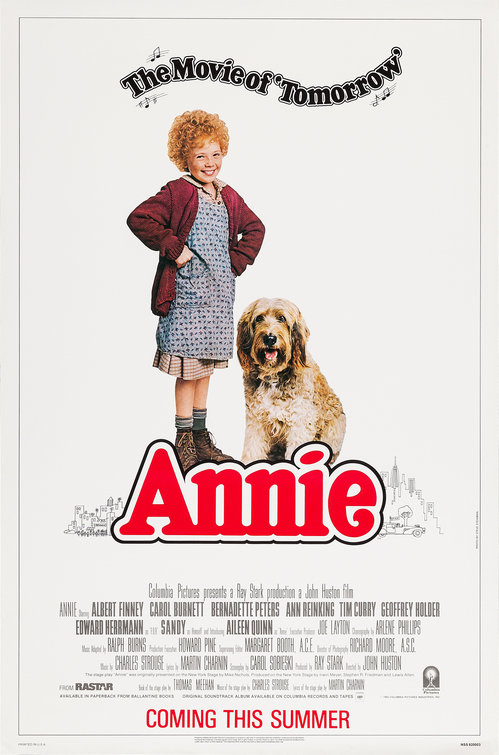
Sure, I'm a theatre major. Sure, I enjoy the occasional, OCCASIONAL, musical. But this! This is the best the 80's has to offer in terms of musicals! What crap! What utter crap! I somehow escaped this filmic version of Annie, as most of my professors prefer to show good musical adaptations such as The Sound of Music or My Fair Lady. But, of course, I felt the need to pay homage to this oft-lauded musical. Fifteen minutes in, I wanted to throw the DVD out of my second-story Pinehurst window. I fought the good fight however, and for the sake of this blog, I suffered.
Perhaps it is due to the fact that my bull-shit meter is very sensitive, or maybe it's just because this musical is dripping banality and trite philosophy, but I had a hard time stomaching the through-line of this film. Granted, we all love to see little orphan Annie struggle to usurp her horrid circumstances and to finally end up in the arms of Daddy Warbucks (played by Albert Finney, you know the cigar-smoking, tommy-gun weilding, bad-ass from Miller's Crossing). But this film believes far too much in sunshine and daisies to warrant anything more than a facile, glossy view of our modern, and their 80's, times. Perhaps, people in the 80's needed a little more sunshine in their lives and a little more hope, but this was certainly not the way to go about it.
On another note entirely, Albert Finney, Tim Curry, Carol Burnett, and Bernadette Peters (the latter three having solid Broadway careers, as well) turn out impeccable performances. It is odd to see these three performers finding nuance and subtlety in a script that is devoid of complication and intrigue. These performances make the musical stomach-worthy at points, but once little Annie opens her mouth...it's all over. Perhaps I am being unduly harsh, but the 80's turned out some of the greatest films of all time, this is one of those exceptions. What a waste of talent...
Ever wondered what might occur if a blind man and a deaf man were partial witnesses to a murder and were subsequently swept up in the investigation, tagged as suspects, and then acted as vigilantes attempting to clear their own names? I give you 1989's See No Evil, Hear No Evil. This movie stars the nearly unstoppable (and quintessential 80's dynamic duo) team of Richard Pryor and Gene Wilder. Apart they are comedic geniuses, separate they are comedic gods.
With all honesty, it is the acting of this solid duo that saves this rather lackluster film: The plot is a little meandering, and begs the audience to make a lot of allowances for the two leads; the script, if removed from the performance context, is rather trite and borderline handicap-advocacy. All of that aside, the film does raise some interesting questions about the portrayal of handicaps on screen and our reaction to them.
I truly felt that Wilder, in particular, went to great lengths to create and simulate the accuracies of being deaf, with Pryor taking a more comedic blind route. But the script asks us to view the men both as stereotyped but also very humanized. At moments in the film the two men, taking considerable time out of their crime-escaping endeavors, sit and talk to one another. What the audience is privy to are one, some beautiful acting, and two some very heartfelt dialogue that truly paints a unique picture of the two men, of two handicaps. But it also seems that the writers want us to view them as bumbling fools at times, that their handicaps have turned them into idiots and then in the next they are total geniuses as they outwit cops, hotel maids, and hardened criminals.
Ultimately, I found the script a little unbalanced and lacked finesse in the creation of the characters. But this film is more about the slapstick and the comedy and in those two arenas it excels to an immense degree. Oddly enough, Pryor's character Wally espouses an interesting moral philosophy, which is summed up in the phrase, "Fuck it." Much of the journey of the piece, for the two characters (part of the script which is solid) is their learning when to say, "fuck it," and throw their handicap to the winds and when saying "fuck it," may be less than appropriate.