Monday, May 01, 2006

spaceballs: The Blog


In need of some serious de-stressing because of finals, my friends and I decided to have a movie night of completely hilarious comedies that only get better the more times you watch them. Spaceballs was of course included in the mix, because what’s a night of comedy without some Mel Brooks and humor manifested out of taking figures of speech and making them literal. (I’m also madly in love with Bill Pullman, but that’s a different story all together.) The combination of Mel Brooks, Rick Moranis, John Candy, Joan Rivers, and (how could I forget) Bill Pullman is magnificent. Each actor/actress is so perfectly cast nothing feels forced. The only awkwardness that’s noticed is what Brooks wants the audience to see, only the elements of awkwardness that contribute to the hilarity of the movie instead of any awkwardness that would take away from it. It seems that every time I watch this movie, I end up wishing it was longer than being only an hour and a half. It also makes me want a “Spaceballs: the t-shirt” t-shirt… or any merchandise from the movie (except of course the flame thrower… that’s just weird.) I grew up on a ridiculously unhealthy amount of Startrek, so this movie is right up my alley. And it should be up yours too, unless of course, you don’t like to laugh.

Get in your mouse, and get out of here!


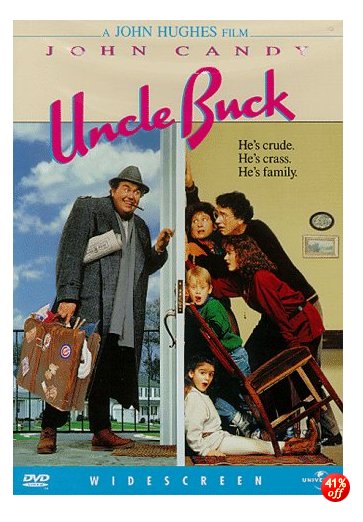
Uncle Buck is one of those quintessential 80’s movies of everyone’s childhood that they love and adore and still love to watch today. And like most quintessential 80’s movies, one that I missed out on. (Just in case you’re wondering: I also missed out on Pretty in Pink, Sixteen Candles, didn’t see Ferris Buellers’ Day Off until I was at least 16, and have yet to see any of the StarWars, Jaws, or Rambo movies.) The film’s been referenced to so often in my life (my dad goes by Buck… don’t ask) that I finally decided to see it. The fact that John Candy and Macaulay Culkin (pre-early marriage and nasty divorce, and as it would have it pre-Home Alone as well… that I did see) both star in the film definitely doesn’t hurt it. John Candy plays a sleazy bachelor who is called upon by his brother to watch his nieces and nephew after his sister-in-law’s father has a heart attack. The youngster kids immediately take to his “charm,” but the older, more rebellious Tia played by Jean Louisa Kelly takes a while to warm up to him, especially when drama ensues as Uncle Buck immediately recognizes that her boyfriend, Bug, is also a sleazeball and only using her for sex. By the end of the movie, Uncle Buck has won Tia’s heart, saved her from a bad relationships, and even helped her and her mother’s relationship. All in all, the movie was good, but a classic? Maybe after I watch it enough to start quoting it like everyone else.

Awesome! Totally Awesome! All right, Hamilton!

Fast Times at Ridgemont High is a true 1980s film with its cast chock-full of teenagers rebelling against adults, parents, anybody, through their partying, sexual exploits and slacker behavior. This movie was released in 1982 based on the book of the same name by Camerone Crowe. It is based partially on reality and what Crowe experienced while posing as a student at a San Diego high school.

The film focuses around a young girls dilemma over sex and a relationship. Played by Jennifer Jason Leigh, Stacy Hamilton struggles to find out what is more important to her, having copious amounts of sex with random people or having a relationship. It comments on high school life as the directors try to portray a seemingly realistic high school situation. It is filled with stereotypical high school characters, such as the stoner kid named Spicoli, played by Sean Penn, the genuine but nervous, almost geeky character of Mark who finds himself at a loss of words every time he is near a girl, then there is the sexually experienced and seductive best friend, and the highly optimistic, even though his life sucks, brother of Stacy, played by Judge Reinhold.

The film is entertaining, although it moves pretty quickly through the span of one year, spending only five minutes on the ins and outs of Stacy's abortion, the budding romances between certain characters, etc.

Awakenings (1990)

Imagine being trapped in your own body and mind with little to no hope of escaping.
Imagine not being able to communicate with other people around you including your loved ones!
Imagine that everyone sees you as already being dead inside, but you are very much alive.

This movie, which is based on a true story, shows just how scary and mysterious the human body can be. It portrays the frustration and desperation that can be present when modern medicine can’t give an explanation or a lasting solution to a debilitating illness to either the patient or the patient’s loved ones.

Dr. Malcolm Sayer , a neurologist (Robin Willams) arrives at a state hospital in hopes of attaining a position in neuroscience research. To his dismay, he finds that the job that he is applying for is a position as a clinical neurologist where he would have to be working one-on-one with living patients. In the beginning, this proved to be a huge shock for the doctor being as his previous “patients” had been earthworms.

As time progresses, Dr. Sayer begins to realize that many patients at the hospital shared common symptomotology. His enthusiasm for research drove him to investigate the patients that other doctors had set aside as being chronic and hopeless. In working with these patients, Dr. Sayer discovers something truly shocking. He discovers that these men and women were truly alive inside-just imprisoned within themselves by their illness. Attacking every angle, Dr. Sayer tries desperately to release these patients from their internal prison.

Dr. Sayer finally learns about a new drug that is being used on patients with Parkinson’s. He manages to convince the hospital to let him test this drug on at least one patient. They hesitantly agreed. The first patient that this drug is administered to is Robert Deniro’s character Leonard. The drug finally has an effect, and Leonard is “awakened” from his dark sleep. Soon, the drug that was tested on Leonard was then given to all of the patients in that hospital who had the same mysterious disease. They too awakened, and were released from their internal prison. However, the drug’s amazing effects do not last, and it is Leonard that we are able to see that the drug is not a cure. He begins to deteriorate and eventually ends up exactly where he began-as incapacitated.

Robert Deniro performance in this movie was truly masterful. As an audience, you are truly experience what it is like to wake up and realize that you have missed out on huge chunk of your life-your loved ones are either old or dead, and you are totally lost in a new world. His performance brings both joy and tremendous sadness. Joy because you realize that he was able to at least join the world one more time; sadness because you realize the limitations of modern medicine.

The Outsiders


Stay Gold!

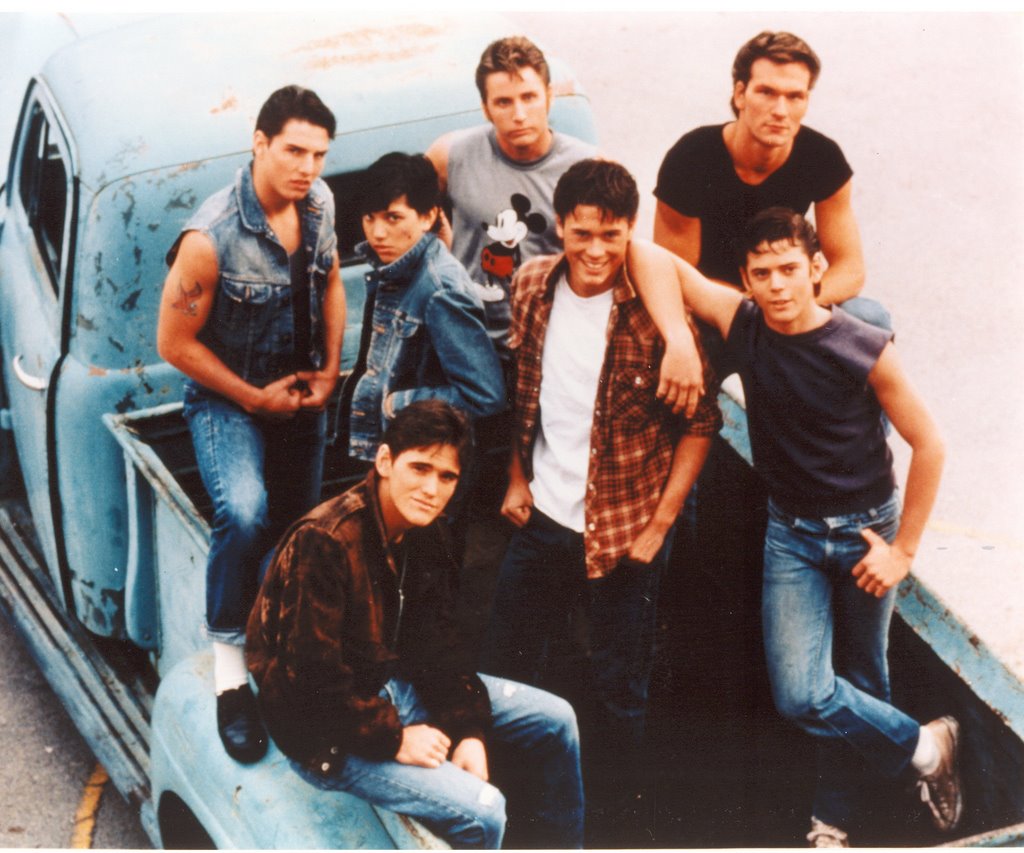
Leading Actors: Patrick Swayze (Darry Curtis), C. Thomas Howell (Pony Boy Curtis), Ralph Macchio (Johnny), Matt Dillon (Dally), Tom Cruise (Steve Randle), Emilo Esteves (Two-Bit), Rob Lowe (Sodapop Curtis), Diane Lane (Cherry)

I decided to watch the movie I had fallen in love with as a child and after watching it again, I can see why it was I was so captured by it.

This movie is an impressive adaptation of the book by S.E. Hinton. The setting takes place in the Midwest amidst a violent territory war between two economic classes: the Greasers (the poor working class) and the Socs (the Socials-the upper class of society).
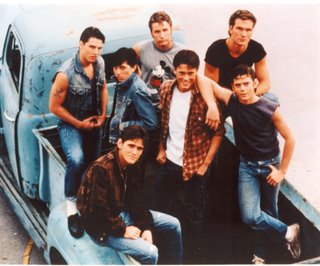
The main storyline is centered on two teenage friends called Pony Boy Curtis and Johnny (Greasers), who are caught in the mix of the social rivalry. The main character, Pony Boy Curtis, is an orphan adolescent being raised by his older brother, Darry. He dreams of a life that is beautiful and peaceful. He escapes to this dream by reading poetry-not a typical activity of a greaser. I believe that it is Pony Boy’s intelligence, innocence and desire for something better that makes him an outsider. He is an outsider to both groups. He’s seen as an outsider by the Socs because of his economic status. However, he is also seen as an outsider in his own gang, the Greasers, because of the aforementioned characteristics. I think that they believe he is destined for something better than what they have to live with everyday.

Pony’s best friend, Johnny, is a traumatized, abused and neglected waif who may as well be considered an orphan by the way his parents treat him. Like Pony Boy, he too is an outsider from both groups. He is an outsider to the Socs because of his economic status and he is an outsider to the Greasers because he is innocent and scared. I don’t think the Greasers see him as an equal, I believe they see him as someone who needs to be taken care of-protected.

I think it’s ironic that the boy who was known to be weak and in need of protection, is the one who saves Pony Boy’s life. Johnny was able to confront his fear of Socs (having once been brutally beaten by one) by shooting a Soc who was attacking Pony Boy. When Pony Boy regained consciousness he realized what had happened. They both sought the help of a friend, Dally, to help them run. It was on the run that Pony Boy and Johnny became heroes. However, heroism wasn’t without its consequences. Upon Dally’s visit to Pony Boy and Johnny, all three boys jumped in to save a group of children from a fire in the abandoned church where they had been hiding out. While attempting to save the last child in the building the ceiling in the church collapsed, severely burning Johnny and Dally. As a result, the boys were returned to their hometown injured and to face the music. However, Johnny did not survive his wounds.

No one could believe that Greasers could be so heroic. It was not a trait that people thought that they possessed. Even the head Soc was baffled. He wasn’t certain that he would have done the same thing as those boys, and he respected them for that. However, that respect did not prevent the planned gang brawl in the end.

Dally also did not make it, but his death was not by fire but out of grief. He had taken on the role of Johnny’s protector. He saw himself in Johnny and didn’t want him to go through the same things as he. The overprotection and care for Johnny is what killed him in the end. Dally couldn’t handle losing Johnny. I think that he saw his only hope for redemption from the mistakes he had made in his life as occurring through Johnny. Once Johnny was dead, he felt as if all hope was lost for him and he cracked. He was ultimately shot by the police.
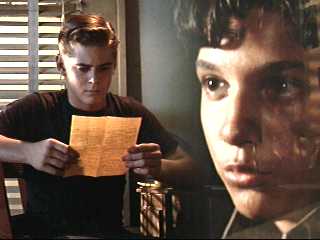
The last piece of advice Johnny left Pony Boy, while kind of corny in the way that it was done in the movie, was very touching. He had recognized that Pony Boy was special, that he was an outsider. He wrote a letter to Pony Boy before he died. He told him that he should always remain innocent, “Stay gold.”

Arthur

Dudley Moore does a fabulous job at playing a drunken, immature socialite who has wasted his entire life living lavishly off his father's money without doing so much as lifting a finger. No wonder this was a top grossing film of the 80s; it represents everything the 80s was all about. It showcases the 80s all-about-me mentality and how it was the age of excess indulgence and carefree consumption. Blissfully unaware of the struggles of a real life, Arthur Bach, a drunken playboy, has lived off his father's money his entire life, however, his parents are tired of his playboy ways now and give him an ultimatum, either he finds a wife and gets married or he doesn't inherit any of their fortune.

Unfortunately, the leading lady and subsequent love interest of Arthur is played by Liza Minelli, who is not in the least bit attractive. Her character in the movie would be an unlikely candidate of Arthur's love. She is the complete opposite of him, growing up with only a father and barely any income. She speaks with an awful accent and appears uneducated if not completley socially inept. Arthur first meets her while shopping in Bergdorf Goodman, except she is not shopping, she is shop-lifting. Arthur comes to her rescue and a relationship ensues between the two. Unfortunately, she is not the type of girl that his parents had in mind to become his wife. They were hoping for a girl of high social status and money equal to their status, not an unattractive poor girl from Queens. Despite the unrealistic aspect of a relationship actually occurring between Arthur and Linda, one does materialize and Dudley Moore does a fabulous job at showing a man truly in love with all the endearing qualities associated with a new love.

This movie is entertaining and, in my opinion, an excellent example of the true essence of the 80s mentality. It should be watched and appreciated by all.

Patrick Swayze sure can dance....

Ever since I first saw this movie, I have spent the majority of my time in pools practicing the moves from the lake scene. Although I have never attempted the jump-catch-and-soar move clad in all white clothing while in water, opting for a bathingsuit instead, I have always found this scene to be my favorite from the 1987 film, Dirty Dancing, although the "No one puts Baby in the corner" scene is definitely a close second. With an all-star cast of the incredible dancing genius Patrick Swayze, the pre-nose-job Jennifer Grey and the late law and order star Jerry Orbach, Dirty Dancing has proved to be a timeless 80s flick.

The movie centers around "Baby" (Jennifer Grey) who has come to stay for a two-week vacation at the Mountain Lake Hotel in Pembroke, Virginia. Baby finds herself caught in a world of 'dirty dancing' after she stumbles upon a "secret" staff party late one night while wandering around the hotel grounds. She is sworn to secrecy and told not to ever come back, but ofcourse, Baby has been bit by the curious bug and can't get enough. She is enticed and sucked into the world of dirty dancing, even though none of the other staff members like her, especially not Patrick Swayze's character, Johnny, and his knocked-up dancing partner Penny, she proceeds to keep coming back to their secret hang out. After she finds out that Penny is pregnant, she takes it upon herself to help, enlisting the medical services of her father to fix the shoddy abortion job Penny received from a sketchy doctor. Because of her operation, Penny cannot perform in the final performance of the year, so Baby comes to the rescue once again. She offers to take Penny's place in the final dance, however, she has no idea how to dance. This means she will need to spend the rest of her free time with the studdly Johnny, learning the dance moves and eventually sparking a romantic relationship. She begins as a clumsy dancer with no talent and she annoys Johnny with her ineptness. However, she refuses to give up and finally is able to perform in the final performance, with only a few slip ups only apparent to her and Johnny, and she finally lands the most difficult move for her, the move where she must run and leap into Johnny's arms as he holds her entire body up above his head.

The movie comments on social classes, with the relationships both Baby and her sister have with the "help" and the subsequent response from their father, who is greatly disappointed and disapproves immensley. Despite the social class implications, the movie is entertaining and clearly awe-inspiring for a six year old girl who seeks to emulate dance moves in pools.

Sunday, April 30, 2006

In Your Eyes

Say Anything is a typical teen 80s movie about a boy who falls in love with a girl who is out of his league. John Cusak plays Lloyd Dobler, a run of the mill guy who doesnt really have anything special going for him. Ione Skye plays Diane Court, a beautiful, smart girl who lives with her single father, John Mahoney, and is getting ready to go to college. Lloyd calls and asks Diane to a party after graduation, and to his and everybody else's surprise, she says yes. At the party, Diane talks to his friends, and finds out that he is actually a pretty good guy. She ends up falling for him; however, he over-bearing father does not approve of the romance. She is supposed to be going to England for a summer scholarship program and her father does not want her to jeopardize the opportunity. They typical image from this film is Llyod standing outside of her window with a jukebox overhead playing Peter Gabriel's In Your Eyes. Llyod's extravagant, yet romantic gesture gets her attention and makes her realize that she truly does love him and wants to be with him.

Amadeus

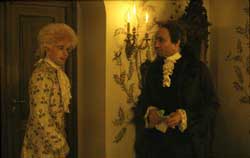
Because of its 18th century setting, Milos Forman’s Amadeus (1984) initially appears to be an atypical 80s film. Look more closely, however, and you’ll realize that its appearance can be deceiving. Illustrated by the contrast between Antonio Salieri (F. Murray Abraham) and his contemporary, Wofgang Amadeus Mozart (Tom Hulce), Amadeus abounds with the popular 80s theme of nonconformity.


Initially a pious Catholic, Salieri begged God to help him be a musician in exchange for a life of chastity and frugality. A conformer, Salieri’s music is unremarkable but acceptable to his patron, the Habsburg emperor Joseph II. Nevertheless, Salieri bitterly recognizes the mediocrity of his own compositions. The talent he spent many years struggling to acquire comes naturally, effortlessly, and in far superior measure to Mozart. Ironically, Mozart’s middle name, “Amadeus,” means “one who loves God” or “loved by God.” Unable to accept that God would grace such an arrogant boor with musical genius, Salieri rejects his faith and vows to ruin Mozart.


The brilliant Mozart, for his part, only conforms enough to make ends meet. He wears outrageous clothing (such as a wild pink wig), lives beyond his means, and both drinks and parties excessively. Even though he needs the money, he refuses to take on students because he says that would be boring and a waste of his talents. He deigns to permit noblemen, churchmen, or wealthy men to be his patrons but composes what he wants, not necessarily what they want. Combined with his uncouth behavior, the “distasteful” content of Mozart’s operas is enough to seriously offend these patrons. As Mozart says, “Forgive me, Majesty. I am a vulgar man! But I assure you, my music is not.”


I won’t spoil the film’s ending for you by describing how Mozart meets his early death and what happens to Salieri afterwards. There is a certain amount of ironic and poetic justice in it, but if you want to find out why, go watch Amadeus yourself!

For more information, see:

Academy Awards and Nominations

  • Won: Best Actor in a Leading Role (F. Murray Abraham); Best Art Direction-Set Direction; Best Costume Design; Best Director; Best Makeup; Best Picture; Best Sound; Best Writing, Screenplay Based on Material from Another Medium
  • Nominated: Best Actor in a Leading Role (Tom Hulce); Best Cinematography; Best Film Editing

Trivia:

  • Jeffrey Jones (Principal Rooney in Ferris Bueller’s Day Off) plays Emperor Joseph II

That's not a knife, that's a knife


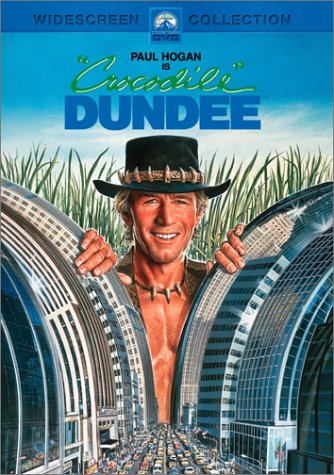
Crocodile Dundee is a film about a New York newspaper journalist who travels to Australia to investigate the legend of a “crocodile man” named Mick Dundee who survived a vicious crocodile attack in the outback. Her investigation leads her into a foreign world that greatly contrasts her big city lifestyle, and she ends up falling in love with Mick, even though she has a relationship back home. She learns about the ways of the aborigines and how Mick grew up in this land that seems so primitive to her. After her visit she convinces Mick to come back to New York with her so she can continue her story and so that he can see what the big city is like. The outsider roles are then reversed and Mick finds himself in a strange world and struggles to fit in, however he becomes a town favorite and is loved by everyone he meets. His struggles are hilarious and he stands out like a sore thumb, providing much entertainment in this film. He encounters transvestites, muggers, and bidets that give him some confusion.


Overall, this film was enjoyable to watch and the plot is interesting. Definitely a classic 80’s film with a very distinct 80’s soundtrack, and some references to 80’s society such as cocaine use, and the importance of money. My favorite scene has to be when the muggers try to attack him with a small switchblade and he pulls out his huge bowie knife, sending them running away in fear. I recommend this one if you want some laughs on a free Saturday afternoon.