Thursday, March 04, 2010

Better Off Dead


Better Off Dead takes place in Northern Calirofornia and follows the life of high-schooler Lane Meyer (John Cusak) whose girlfriend, Beth, breaks up with him for the captain of the high school ski team, Roy Stalin. Lane can't seem to cope with this loss and decides that death is his only choice. His half-assed attempts at suicide always fail, creating some sort of comedic sitauation.

Throughout the film you discover that Lane's family is peculiar. His mother is an odd Stepford wife sort of woman, but lacks cooking skills, his father is convinced that he's on drugs, and his geeky little brother won't speak, but can build lasers and attract trashy women. Lane's best friend, Charles de Marr, inhales everyday substances, such as snow, because he claims that he can't get real drugs.

As Lane attempts to win back the girl or end his own life he gets to know another girl, Monique, who is a French foreign-exchange student. During the school year she's staying with Lane's neighbors who annoy her to the point where she pretends not to know English. She helps restore his confidence and will to live.

In the end, Lane must compete against the guy who stole his girlfriend in a ski contest. Throughout the race, a paperboy consistently bumps into Lane, claiming that he's owed two dollars (creating the catchphrase "I want my two dollars!") As Lane races down the mountain on one ski he overcomes a life gone downhill to find happiness.

Platoon

"Somebody once wrote: "Hell is the impossibility of reason." That's what this place feels like. Hell"
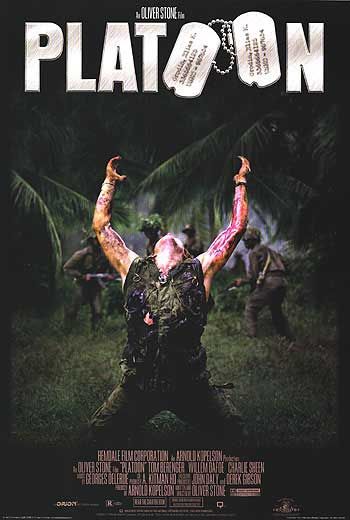
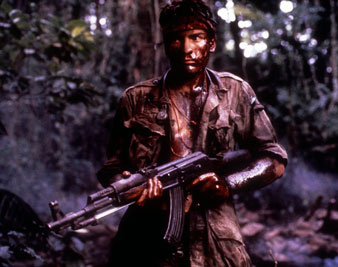
A war film, created in 1986, about a war which took place during the 1960's, being viewed in 2010: Inaccessible, right? Dead wrong. Platoon is as prescient now as it was when it was released, by director Oliver Stone (Director of Wall Street), to the public. This film is operating on several levels: One, it exposes the senselessness of the Vietnam, and in fact all, War(s); two, it provides us with a stirring look at the current disparities caused by race, economic class, and moral fiber, and three, probably most importantly, it forces you to face the, almost Jungian, brutality of man and the limits of violence both against the 'other' and against our fellow brother.In one of the films most striking scenes, this idea of man vs. man is made, rather viscerally, obvious: The platoon that we follow for the duration of the film is divided into two factions, the one supporting Sgt. Elias, portrayed, rather beautifully, by Willem Dafoe, and the other supporting Sgt. Barnes, played by Tom Berenger. Elias is opposed to harming the Vietnamese, fails to understand the need for war, etc. and Barnes is the 'Rambo' figure, gung-ho to win this war, even if it means killing innocent civilians. Elias has gone off by himself to flank a NVA position, but Barnes tells the rest of the troops to fall back and that he will go and find Elias. What then occurs is a fast-paced search sequence, as an audience member you first see the frantic cuts as a reflection of the tension in the scene, but it turns into the tension between the characters; Barnes is no longer searching for Elias, he is hunting him (Think Connell's "The Most Dangerous Game"). Barnes finds Elias and promptly shoots him, supposedly, killing him. These two men are both American soldiers, but they uphold opposing ethical beliefs, and in war, beliefs are all you have, and to Barnes, they are enough to kill over. Because, hell is the impossibility of reason, and war, although caused by logical thought as the Dadaist would say, is devoid of reason; war is emotion, war is man vs. man, a primal undertaking to see whose stick is the biggest.

This film is the Hurt Locker of the 80's and in many ways sets a unique precedent for each war movie that was to follow in its filmic footsteps. This film is operating on multiple levels and is examining universal concepts of morality, violence, and man's inescapable nature. Oh, and be sure to catch a young Johnny Depp smoking the ganja.

The clip that follows is certainly the most famous sequence of the film (a moment from which dons the poster and DVD covers) and occurs just after the scene I described above. Elias, is, after all, not dead...


Wednesday, March 03, 2010

Back to the Future


Back to the Future is no doubt an 80s classic. The starts off in 1985 following the story of Marty McFly, a typical 1980s teenager who is friends with the eccentric but good hearted Dr. Emmet Brown. McFly accidentally gets sent back to 1955 after Doc is attacked by terrorists and feel he must warn him of his future and also compromises his own future when he interferes with his family of the future.

I loved this film. I've felt like a bit of a cultural outcast in the past for having never seen it, so it was an overall positive experience to finally see what the movie is all about. I loved how even though the film was comical, the stakes for the Doc and McFly were life threatening. I thought the characters were all very fun and different to watch as well. Even the bully, Biff, was a character I liked seeing on screen because of his stupidity and humor. It was also interesting to see the dynamic between the characters of how they were in 1985 compared to 1955 and how they became who they are.
The movie definitely fit the time period of the 80s. The style, music, and allusions to pop culture were all very 80s driven. Even though a majority of the movie took place in 1955, McFly retained the 80s atmosphere and actually made the 80s even more present in the movie because he stood out so obviously against the characters and setting of 1955.

I would absolutely recommend this movie to anyone and everyone. Assuming I am not the only person in the year 2010 that hadn't seen this movie, go rent it now. You won't regret it!


Here is a clip that shows a loophole within the film that questions whether or not McFly should still be stuck in 1955 and if Spielberg made a mistake:

http://www.youtube.com/watch?v=P1mqgbNu-J8&NR=1

The Goonies

http://mcaaron.files.wordpress.com/2009/09/the-goonies.jpg

The Goonies
(1985) is a classic comedy about a group of kids (the Goonies) whose families are losing their homes for a rich entrepreneur to build a golf course. This underdog story is written by Spielberg. The kids, or "The Goonies", are a close knit and vibrant group, and they refuse to be forced to move from their lives peacefully. The main character, Mikey, is a cool, composed, and motivated young kid who is definitely the leader of the group and is the one who convinces all the kids to search for "Ol' One Eyed Willy"'s treasure.
Usually, people in an exploited situation like these families are powerless, just as this group is before they find the treasure. But this is a happy ending in that the weak and powerless group gains power with the jewels and treasures that they find by their hard fought journey to the abandoned pirate ship, with a little help from Lotney "Sloth" Fratelli.
The Fratellis are the bad robbers who the kids cross paths with by venturing into their house to get to the treasure. They chase the "Goonies" frantically to gain all the treasure they can for themselves. Mrs. Fratelli is definitely an ethical egoist, in that she uses all her sons to her own advantage. She even tries to hoax Sloth into siding with her during the fight for the treasure, lying to him and telling him how much she loves him.
In the end, the good guys come out on top and the jewels save the day for the Goonies. It makes for good film to see a David vs. Goliath battle won by the underdog, and this film certainly would fall into the category of an underdog story. For anyone who hasn't seen it, The Goonies is a must see.

Tuesday, March 02, 2010

Goodfellas: Are these guys really good fellas


Martin Scorcese's Goodfellas (1990) is an interesting film to analyze ethically. Even though it came out in the 90's technically, it was filmed and written in the 80's in a time when the American mafia was a huge issue as it spilled over from the Sicilian mafia. The mafia was involved in drugs, extortions, prostitution, and all sorts of black market activity.
The protagonist Henry (Ray Liotta) grows up in New York in a mafia neighborhood, and goes against his parents' will and starts running errands for the mafia crew across the street. Scorcese and many directors alike usually portray the mafia in a sort of positive light, in that they are tough and sort of cool guys. Scorcese portrays Paulie (Paul Sorvino), the head mafiosi, continually throughout the film as a good guy who uses his brain to make morally right decisions. Henry's parents seem like jerks from the way they treat him and Paulie seems like the great guy.
The other two main mafiosi are Jimmy (Robert de Niro) and Tommy (Joe Pesci). Tommy ends up being killed because he messed with a guy who was a "made man." The mafia bosses, above Paulie even, set up Tommy, telling him that they are "making" him, and kill him for violating one of their own. But just because they say that a guy is a "made guy" it's alright to beat up whoever they want? It's as if they're some sort of controlling force who can demand people to ethically behave while they "the mafia" can reign free.
And the mafia is a problem that cannot be controlled. If anyone threatens the mafia, those people's families will be put through unimaginable torture. And yet, in film, the mafia is portrayed, except in rare films, as the good guys. Film critics are willing to put aside the fact that people kill for a living because mafiosi are tough guys that are entertaining to watch.

Sincerely Yours, The Breakfast Club

The Breakfast Club takes place in Shermer High School, located in Illinois, and centers around five teenagers sentenced to Saturday detention. The five students, who appear to have nothing in common, congregate in the school's library, where they are ordered not to speak or move from their seats by their principal, Mr. Richard Vernon. Brian, Allison, Claire, Andrew, and John are forced to remain in the library for eight hours and are assigned a 1,000 word essay describing who they perceive themselves to be.

In order to pass the time they gradually begin to open up to one another despite the fact that, normally, they would never converse. They eventually discover that each of them have strained relationships with their parents and that they fear becoming like the adults around them. Despite their developing friendship, the group worries that once they finish detention they will return to their differing cliques and refuse to speak to one another.

The consensus of the group is that Brian write Mr. Vernon's essay:

Brian Johnson: Dear Mr. Vernon, we accept the fact that we had to sacrifice a whole Saturday in detention for whatever it was we did wrong...but we think you're crazy to make us write an essay telling you who we think we are. You see us as you want to see us... In the simplest terms and the most convenient definitions. But what we found out is that each one of us is a brain...
Andrew Clark: ...and an athlete...
Allison Reynolds: ...and a basket case...
Claire Standish: ...a princess...
John Bender: ...and a criminal...
Brian Johnson: Does that answer your question? Sincerely yours, the Breakfast Club

This movie is quintessentially 80s due to the fashion, music, characters, and the fact that Molly Ringwald and Anthony Michael Hall are in it together. Not to mention that it's a John Hughes film.


Monday, March 01, 2010

Romancing the Stone


My mom recommended that I watch Romancing the Stone when I told her that I needed to watch 80’s films that I hadn’t seen before. I’m glad she did, because it was such a sweet, but simultaneously adventurous movie, full of wide-ranging laughs for everyone.

Romancing the Stone is an Indiana Jones-esque film and even harkens back to the classic days of film, showcasing exotic locations and even a hand-drawn movie poster. The film begins as an adventurous western love story, which is quickly revealed as the creative invention of romance writer, Joan Wilder. However, Wilder finds herself thrust into her own real life adventure, inspiring the most wonderful love story of all, when her sister is held hostage in Cartagena, Colombia and can only be ransomed by a map that was sent to her by her murdered brother-in-law.  

The accomplished author quickly finds herself in a distant land where she doesn’t know the language and is unknowingly followed by Colonel Zolo, the man who murdered Joan’s brother-in-law, as well as the comical Ralph, who is in cahoots with her sister’s captors, all of whom seek the map. Joan soon meets Jack Colton, who rescues her from Zolo and helps her through the jungle in search of Cartagena in exchange for the traveler’s checks that Joan has. They soon begin to fall in love as they venture through the mystic land of Colombia and decide to follow the treasure map to find what everyone is looking for. The map guides Joan and Jack to discover the illustrious Corozon Emerald, only to be chased by Ralph and a team led by Zolo and led down a careening waterfall, ending up on opposite sides of a raging river. While gunfire ensues from above them, they promise to meet each other in Cartagena, Joan with the map and Jack with the emerald.

            Once in Cartagena, Joan fears that Jack has abandoned her, using her emotions to “romance the stone” away from her. She meets with her sister’s captors and gives them the map, and is set free. However, Zolo quickly arrives, knowing that the Emerald is no longer hidden. Jack enters heroically, only to have the stone taken by Zolo, who then proceeds to lose the emerald, along with his hand, to a hungry crocodile. Chaos ensues as Jack follows the crocodile and Joan fights for her life against the knife-wielding Zolo while calling for help. Jack is forced to choose between the unparalleled riches hidden in the crocodile belly and the woman that he has grown to love. He gives up the crocodile, and reaches the struggle just as Zolo falls to his demise in a pit of crocodiles. Joan and Jack share a kiss just before takes off in search of the crocodile once more.

Once back in New York, Joan turns her experiences in Colombia into the best novel of her career. However, still distraught that her own love story has not come true, Joan goes home to find the surprise of her life as Jack stands atop his dream sailboat wearing crocodile-skin boots, waiting to carry her off into the New York sunset.

The film plays off of the great success of the exotic adventure genre, while providing a sweet love story to go along with it. Not just an adventure, Romancing the Stone, is a full figured action, romance and comedy, sure to entertain a broad audience for years to come.

Here's a link to the trailer for the film. I think it's done in a really creative way.

Terminator


'Terminator' is a classic 80s action film starring Arnold Schwarzenegger. In the film, the Terminator is sent back in time to kill a lady named Sarah Connor who will, in the future, have a son who will go on to be a war hero fighting against these machines. In the future these machines have taken over the world and are trying to exterminate humans.

Throughout the movie there is tons of fighting action and gore not to mention a ridiculous amount of shooting and explosions. As the first of the Terminator trilogy, this movie is excellent at setting up the prestige for the storyline. Watching the movie we can definitely see that it is set in the 80s: the hair is big and teased, the music is electronic and slightly techno-y, and the clothes are straight from the 80s. The one major flaw of the film is that it was produced a little early in terms of computer technology so the animations seem very fake and computerized. A few years later this film could have had outstanding graphics but I'm sure the digitally remastered films have improved on that.


Overall this is definitely one of the classic 80s action films that is a must-see, such as Rambo and Rocky. The rest of the trilogy goes on to build on this story and every one of the trilogy has been a blockbuster hit. Personally I would consider this movie to be Arnolds ground breaking film which helped to develop his career as an actor and famous action film star. If you like shooting, fighting and explosions you have to watch the Terminator.

Dead Poets Society


The Dead Poets Society is a classic coming-of-age story, timeless for generations to come. It opens with a lecture from the ancient headmaster at the strict preparatory boys school, Welton Academy. The audience soon meets the main group of boys the film follows, young, bright boys all preparing for a future as leaders of their respective fields. They are enrolled in a poetry course taught by the new teacher John Keating (Robin Williams), where he focuses on the idea of independent thinking and the dangers of conformity--namely, a life less lived. "Carpe Diem" is the main theme of Keating's class.

Each of the boys internalize this lesson differently, which drives the plot of the film. Our main protagonist, Todd Anderson (Ethan Hawke), is painfully introverted because he doesn't feel others value him or his thoughts, a result of his family dynamics. Throughout the course of the film, Todd learns to open up to others and to even (occasionally) lead others to defy authority. For Knox Overstreet (Josh Charles), "carpe diem" means to pursue Chris, the girl of his dreams who is seriously dating a lead member of the football team of the local high school. Knox writes her poems, brings her flowers, gets punched out by her boyfriend, brings her to a play, all in an effort to win over her affection. For Neil Perry (Robert Sean Leonard), Keating's lessons inspire him to stand up to his controlling father and to audition (and accept) the lead role in a local play. He pursues his passion for acting instead of obeying his father, who pushes him to drop electives to pursue his goal of having his son go to Harvard to be a doctor.


The title of the film is adopted from the secret club the boys form—the dead poets society—inspired by Keatings, who founded the society during his tenure at Welton. The movie is full of drama and character development, sure to be a timeless piece given its lessons and quality.


Sunday, February 28, 2010

Fletch-Master of Disguise


Chevy Chase plays Irwin Fletch, an undercover reporter in Los Angeles investigating his latest story on drug trafficking. A wealthy businessman named Alan Stanwyk, played by Tim Matheson, approaches him while undercover at the beach. Stanwyk proposes a proposition to Fletch. If Fletch kills Stanwyk he acquires a large sum of money and the assurance/guarantee that he will not be caught with a plan ticket to Rio. Fletch agrees but later becomes suspicious. While taking on many bizarre disguises, he uncovers the truth about Stanwyk’s intentions and the chief of police involvement in the drug situation.

Fletch is definitely an eighties movie. You cannot have an eighties movie without some cheesiness, especially with the nonchalant manipulation and the selection of music for the background, with the hit “Bit by Bit” by Stephanie Mills. The clothes definitely allowed me to get an insight on the fashion of the 80s. Though the cast is not spectacular, it does feature Geena Davis as a secretary and investigating sidekick to Fletch, Fat Sam played by Cheers star George Wendt and Tim Matheson who costarred with John Belushi in Animal House. However the main star of course is Chevy Chase. After the National Lampoon series, Chase joined Saturday Night Live with Steve Martin. Chase may not be well known to today’s generation due to his limited exposure on the screen.

I thoroughly enjoyed the movie and was chuckling about the wisecracking jokes and his apparent love for the Los Angeles Lakers, seeing that he wears a Lakers t-shirt whenever he can. I would recommend this movie to anyone who would want to see Chevy Chase at one of his best performances besides National Lampoon.