Sunday, April 18, 2010

Overboard


Overboard tells the story of Joanna Stayton is a pretentious, narcissistic socialite who treats everyone as though they are beneath her. She employs Dean Proffitt to be her carpenter and fires him upon finding out that he didn’t use the right kind of wood she wanted. One night, she goes to find her wedding ring and while trying to reach for it falls overboard. She wakes up in the hospital to find that she has suffered from amnesia due to the fall and cold waters. Dean sees her on the news and devises a plan to pretend they are married and call her “Annie”. He takes her home with him and she becomes the new mother of the house by having to take care of the kids, cook and clean the house. The movie follows the couple as they learn to fall in love with each other. At the end of the movie, Annie regains her memory when her husband finally comes to find her. We see her struggling to choose between her previous upper-class life versus her new one.

I am a sucker for corny romance-comedies. I found this movie to be hilarious as we see Dean constantly coming up with ridiculous responses to Annie’s questions about their past life together. Goldie Hawn’s acting as a mean stuck up bitch transforming into a caring down to earth girl was well done. We see her struggles and laugh as she tries to become a good housewife. Although this is not considered to be an 80’s classic, it is still entertaining to watch. It becomes apparent that a good 80’s movie does not necessarily need the typical 80’s music and clothes. The plot is unrealistic but nonetheless you are sucked into falling in love with all the characters and rooting for Dean and Annie to end up together.

Redrum- The Shining


“The Shining” was definitely one of the coolest movies I’ve ever seen and definitely proves why Jack Nicholson is still a huge movie star today. The film builds up fear perfectly by really dragging you into the Overlook Hotel with the Torrances, isolated in the middle of nowhere. At first for a while, the film is not overly jumpy scary but works on setting the scene for a family to start to go crazy with the isolation and the bad vibe given by the ghosts, instead of just scaring the audience with cheap special effects of ghosts popping up. This element along with the “gift” the little boy has to see the terrible things that happened in the past or are going to happen and how Jack starts to be manipulated by the ghosts gradually makes the movie more terrifying. The visions Danny sees, especially of the two twin girls covered in blood in the hallway, set up a background story of a father just like Jack, going crazy there and butchering his family. Danny Lloyd who plays Danny, does a fantastic job at such a young age, making it believable to the audience that he does have the ability to see things especially with the faces he makes. Unlike most movies, he is not just the annoying kid but a key factor in the plot line. Jack Nicholson also was amazing in the film because he made a believable 180 turn from a nice father to a complete psycho. The scene where he chases Wendy, Shelley Duvall who’s got the scared to death look on her face down perfectly, made me wonder if I was more afraid of the ghosts or of Jack in the film. The ghosts were just so weird and creepy especially in the bathtub scene which was absolutely disgusting. The scene where Wendy is running around alone and keeps finding the ghosts taunting her is my favorite scene because it really shows how this is a psychological horror film and not just gruesome or cheesy one. It’s not enough that she had to run away from her crazy husband trying to kill her and her son but also a bunch of ghosts messing with her head too now, along with her son who she has to worry about because he seems to be taken over by the boy living in his mouth. Even when there is a chance of hope that Dick Hallorann is going to come save them, that’s shot to hell as soon as he walks in and Jack takes an ax to him. Even though Wendy and Danny get away, you can’t even say it’s a happy ending because of what happened to Jack, who dies in a different and surprising way by being frozen solid instead of killed by Wendy or Danny. This movie really messes with your mind and scares you with things you wouldn’t think would like typing same thing on a paper, an overflow of blood from the elevator or just ghosts standing at the end of the hall yet not doing anything. There is just so much creepiness and weirdness going on throughout the movie that it’s hard not to get sucked in and then be freaked out for the rest of the night after watching it. How Stanley Kubrick portrayed the characters, ghosts and the hotel’s past and present, even adding the picture at the end that left the audience think wtf?, is what made this one of the greatest horror movies of all time.

"What are you, people? On dope? " -Mr Hand.


Fast Times at Ridgemont High is a coming-of-age teen comedy that follows a group of high school students lives. It follows Stacy Hamilton and Mark Ratner with their many friends and what romance means to them.

I found this movie to be highly entertaining and easy to watch. It was interesting to see how particular actors have grown since such as Sean Penn, Forest Whitaker and Nicholas Cage. Penn in particular played the hilarious stereotypical stoned surfer boy who has no interest in school but would rather cut class, get high and hit the waves. Penn sets the tone of fun and funny for the entire movie. His relationship with Mr. Hand was particularly amusing as you see the typical harsh professor who thinks everyone is on dope and his interaction with the stoned lazy student.


Stacy on the other hand, is stereotypical 15 year old girl looking to have sex for the first time. We follow her trying to find the right guy while facing many problems along the way. This movie portrays stereotypes in a new way. They are not portrayed as the “jock” “nerd” or “loser” but as typical teens with part-time jobs trying to make it through high school. It is refreshing not to have the same stereotypes played out. Granted, there is the “stoner” but we also see a girl seeking a special relationship, another with a long distance relationship with a guy in college, a guy who is incapable of being committed to one girl and a guy who questions his current relationship and wants freedom. These cover the problems that many people face not only in high school but also in their everyday lives.

Friday, April 16, 2010

The 'Burbs


Joe Dante's dark comedy is about the suburbs and the crazy people who live there.

It begins with the camera descending from outer space, zooming in to the average American cul-de-sac. The "aliens" in this film, though, are new neighbors, whose dilapidated mansion emits a strange hum at night.

Suburbia is a seemingly-idyllic, but infernal world: Vietnam vet Mark Rumsfield, bare-chested and with military shades, raises the flag on his yard and steps in dog poop, Art Weingartner nearly kills Ray while trying to shoot some crows, and Ray is attacked by killer bees when he tries to speak with the new neighbors. Soon the mysterious Klopeks, who only go outside for nocturnal digging sessions, until the men of the subdivision are plagued with paranoia and visions of human sacrifice. At this point, it's up to the wives to get them invited into the mausoleum, where Ray is given sardines and pretzels to show what he is made of under the scrutiny of Uncle Reuben and Werner emerges from his basement in red-soaked duds. ("Sometimes I get carried away.")

Dante has a knack for finding the comedy in the normality of American suburbia. The 'Burbs isn't by any means a deep film, but it is certainly an enjoyable one, and so quintessentially '80s.

The Boy Who Could Fly

Following the death of her father, Milly moves into a new neighborhood with her younger brother and her mother. There, she sees Eric, an autistic boy who lives with his alcoholic uncle, and who has a strange habit of standing on the roof of his house pretending to fly.

Eric doesn't communicate with anyone, but with Milly he makes a slow progress. First, he mimics her movements, and eventually he smiles on his own. On a school field trip, Milly falls off a bridge while trying to pick a rose. She wakes up in the hospital with no serious injuries, and is convinced that Eric can fly, that he caught her as she fell.

As the story progresses, the audience learns that Milly's father was terminally ill and committed suicide because he didn't want to make his family go through treatment with him. Eric's parents died in a car crash, and somehow, in the instant of their deaths, he knew; he did the only thing he knew how to in order to save them (become an airplane), and he's been doing it ever since. The fact that two children have experienced such tragedy and then come together transforms what could be a depressing film into a highly uplifting one.

Clearly drawing inspiration from the Peter Pan story, The Boy Who Could Fly proves itself to be more than the usual '80s teenage fare. Sure, it may be corny at times, but somehow it manages to balance the weighty issues of suicide, mental illness, and bullying with those of love and understanding. If only all real-life stories worked out this way.

Thursday, April 15, 2010


The Princess Bride (1987) is an eighties movie that has elements to appeal to everyone. There is love, action, adventure, humor, and intrigue. The movie begins with an old man reading a story to his grandson. The book is The Princess Bride, and the movie unfolds from there. The main characters are Buttercup and Wesley, a maiden and the farm boy who falls in love with her. Unfortunately, Wesley is captured by the Dread Pirate Roberts and presumed dead, inducing Buttercup to marry Prince Humperdinck. However, true love prevails when it turns out that Wesley has merely become the Dread Pirate Roberts. He attempts to rescue Buttercup from the clutches of Humperdinck and a band of kidnappers.


The side characters in this film are what make it enjoyable for me. The rhyming giant Fezzik and his adoring friend Inigo Montoya are amusing and relatable. My favorite character is Billy Crystal as Miracle Max, charged with bringing Wesley back to life after Humperdinck’s sidekick Count Rugen. Coincidently, Count Rugen was also Inigo Montoya’s father’s murderer. Inigo’s search for revenge on the six-fingered man who killed his father pervades throughout the movie.


This film is distinctly eighties because of the appeal it holds for all audiences. The Princess Bride became an instant cult classic, and its relevance will continue for multiple generations. My friends who were not even alive when it was released still quote “Anybody want a peanut?”, and there are countless t-shirts with “Hello. My name is Inigo Montoya. You killed my father. Prepare to die.”


I would recommend this film to anyone that hasn’t seen it, as it has elements of multiple genres. It is definitely worth two hours of time, if only to understand the countless references made to it.

Tootsie (1982)


Dustin Hoffman continues to impress me in the 80s films, which makes me wonder what the hell he was thinking when he decided to sign on for Meet the Fockers. This hilarious comedy revolves around an unemployed actor named Michael Dorsey, who disguises himself as a woman, Dorothy Michaels, in order to land a part in a TV soap opera; a role which proves incredibly successful. Meanwhile, Michael falls in love with the soap's female star, Julie, but cannot divulge Dorothy's secret or will lose his acting job. Unfolding events are further complicated by the fact that Julie's father, Les, is in love with Dorothy himself.

If you haven't seen "Tootsie", watch it. You'll never regret whiling away a couple of hours with this wonderful ensemble. And it will get you thinking about gender roles, something we as a society are still struggling with today. My personal favorite was Hoffman's moment of truth, when he explains to Lange near the end, "I was a better man with you, when I was a woman, than I ever was with any woman when I was a man." If you can puzzle through the logic you'll see that this simple statement holds a world of truth in its couple of dozen words.

Heathers (1988)


I'd seen Heathers years and years ago, but as we watched film clips in class, I realized I didn't remember one single thing about this movie. After watching it again I realize why. I know it's been compared to Mean Girls quite often, but I think the only real thing they have in common is the number of girls in the clique. Switching face cream f or foot cream is not quite the same as framing a suicide. One thing I thought I remembered was liking Christian Slater, but that must have been false because he creeped me out beyond belief. Perhaps this is due largely in part to how stressed I've been lately, but I thought certain parts dragged and others were so contrived that I got annoyed.

It may be because this movie is held in such high regard, but I wouldn't consider it a classic at all, mostly because it's so dated already. The dialogue is amusing at times, and has certainly spurned a few catchphrases, but I just felt that there were so many other lines trying to be catchphrases that they lost their charm. I also wanted more cheerleader Heather and more Martha "Dumptruck." I also wish Veronica was a bit more developed because she felt kind of flat for me, even though we essentially get inside her head when she writes in her diary. All in all, Heathers is not a bad movie, but I have a hard time understanding why it's made out to be such a "classic".

La Femme Nikita


La Femme Nikita (1990) is one of the few famous eighties movies from a different country. Though I am not normally a foreign film buff, I am always up for a spy/assassin movie. La Femme Nikita did not disappoint. However, it is not a movie to watch expecting a happy ending or hoping for a positive outcome. Nikita, the main character, starts out as a cop-killing drug addict. When she is sentenced to death through lethal injection, the “government” decides to give her another chance. She is trained in a secret facility to become a government agent. Lessons involve fighting, shooting, and feminine advantages. Though her progress seems null at first and she is rude and belligerent to her teachers, her supervisor Bob convinces her to keep trying.

This is not a happy film. There is a lot shown about killing people and the psychological consequences that it eventually leads to. Being an assassin is a great job until you fall in love and have to keep a secret, or your mission messes up and you find out what assassins needs to be capable of. While I enjoyed this movie, it definitely wasn’t what I was expecting. Though I could see the similarities to Pretty Woman in Nikita’s transformation, Pretty Woman was uplifting and hopeful. La Femme Nikita just made me feel pity and sadness.

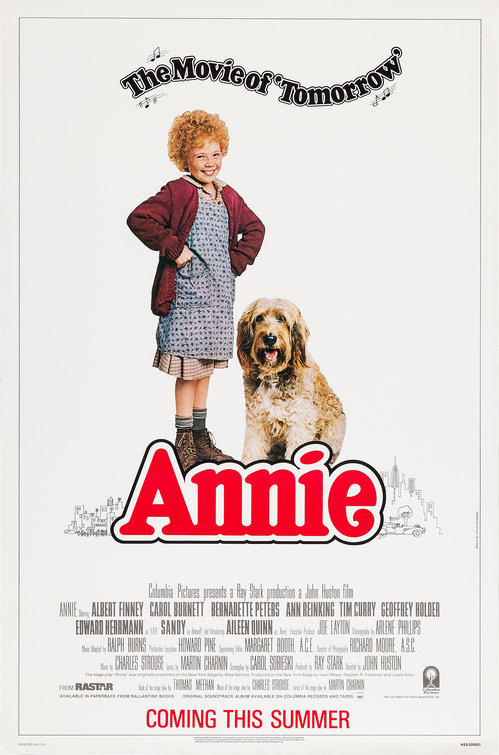
Annie

"Buddha says, 'A child without courage is like a night without stars!'"

Sure, I'm a theatre major. Sure, I enjoy the occasional, OCCASIONAL, musical. But this! This is the best the 80's has to offer in terms of musicals! What crap! What utter crap! I somehow escaped this filmic version of Annie, as most of my professors prefer to show good musical adaptations such as The Sound of Music or My Fair Lady. But, of course, I felt the need to pay homage to this oft-lauded musical. Fifteen minutes in, I wanted to throw the DVD out of my second-story Pinehurst window. I fought the good fight however, and for the sake of this blog, I suffered.

Perhaps it is due to the fact that my bull-shit meter is very sensitive, or maybe it's just because this musical is dripping banality and trite philosophy, but I had a hard time stomaching the through-line of this film. Granted, we all love to see little orphan Annie struggle to usurp her horrid circumstances and to finally end up in the arms of Daddy Warbucks (played by Albert Finney, you know the cigar-smoking, tommy-gun weilding, bad-ass from Miller's Crossing). But this film believes far too much in sunshine and daisies to warrant anything more than a facile, glossy view of our modern, and their 80's, times. Perhaps, people in the 80's needed a little more sunshine in their lives and a little more hope, but this was certainly not the way to go about it.

On another note entirely, Albert Finney, Tim Curry, Carol Burnett, and Bernadette Peters (the latter three having solid Broadway careers, as well) turn out impeccable performances. It is odd to see these three performers finding nuance and subtlety in a script that is devoid of complication and intrigue. These performances make the musical stomach-worthy at points, but once little Annie opens her mouth...it's all over. Perhaps I am being unduly harsh, but the 80's turned out some of the greatest films of all time, this is one of those exceptions. What a waste of talent...

Warning: Small children singing in falsetto and dancing *shudder*