Disclaimer: This is disturbing, and by that I mean: Great fun!
Friday, March 05, 2010
The Thing
Disclaimer: This is disturbing, and by that I mean: Great fun!
The Breakfast Club

I have seen bits and pieces of Breakfast Club when I was younger but never watched it in its full entirety. My previous views were that it was a cult classic and a good comedy. However, after recently watching it I found that I did not enjoy it all that much and that my expectations were not met. Perhaps my maturity has become a factor in this but I found the movie uneventful and the characters overly dramatic in their teen-anxt outbursts. I found it unrealistic that students would divulge so much to one another in one day without having ever previously met each other. I believe that this movie is a cult classic because firstly, Molly Ringwald is in it who was considered an 80’s icon and secondly John Hughes scripted many of the other cult classics such as Ferris Bueller’s Day Off, Weird Science, Pretty in Pink and Sixteen Candles (all classics of that time period). This 1985 American teen comedy is something I would recommend to young teen girls who are looking for an easy watch. The stereotypes represented are those that are still present in society today. Therefore this movie stands against time since it is timeless in the sense that there will always be the jock, nerd, freak, rebel and basketcase. The positive factor that you get out of this film is seeing that you should never judge a book by its cover. Everyone has their own problems and this movie teaches teens that important lesson. Each individual who has attended high school can relate to at least one of these teens represented in the film.
The important lesson to learn:
http://www.youtube.com/watch?v=Sv1I4q6lOpo
Fame: "Remember my name" (1980)
Fame is set at New York's High School of Performing Arts, where talented teens train for arts-related careers. The film is concentrated on gifted students: singer Coco (Irene Cara), actors Montgomery (Paul McCrane) and Ralph (Barry Miller), dancer Leroy (Gene Anthony Ray), and musician Bruno (Lee Currieri). Director Alan Parker illustrates an inspiring story of rough New York teenagers who are given free rein to grow up and make their own journeys while attending an arts high school; their talent enables them to overcome their backgrounds, their sometimes terrifying social issues, and their own personal shortcomings. Followed by Footloose and Dirty Dancing, Fame is one of the most prominent films focused on dance and the arts as a metaphor for successful development and maturation. Although a distinctly 80s film due to the teenage fashions and award nominated soundtrack, Fame stands the test of time as it deals with students and their struggles, trials, and efforts to succeed; Montgomery deals with his own acceptance of his sexuality and Coco is forced to consider how far she’s willing to go to achieve great success. In addition to these conflicts, Fame also emphasizes the importance of keeping up one's academic achievements in an arts specialized school. The music and dancing are spectacular and entertaining with spontaneous dancing in the streets as well as a staged, ending musical performance at graduation. Fame is a feel-good movie and remains relevant to current audiences. A remake of Fame was released in 2009.
Stanley Kubrick's The Shining: "The first epic horror film" (1980)
A quintessential cult classic, Stanley Kubrick's The Shining features the Torrence family and their winter residence as off-season caretakers for the isolated Overlook Hotel. The film is fabulously freaky and whether it’s bloody hallways, attention crazed and creepy twins, or a menacing maze made of hedges, Kubrick manages to feature multiple moments of nail-biting suspense, successfully keeping the innocent and unsuspecting movie viewer on the edge of their seat. Jack Torrence (Jack Nicholson) an amiable and aspiring writer is quickly possessed by the evil atmosphere of the Overlook Hotel and threatens to lose control and seriously slaughter his wife (Shelley Duvall) and son (Danny Lloyd). Kubrick effectively organizes this epic horror and illustrates Jack’s psychotic progression through documenting the days of the week as they become increasingly deadlier. Trapped and alone, Wendy and Danny Torrence are on their own to protect themselves against the Overlook’s supernatural power and the haunting hotel’s effect on Jack. It is this defenseless feeling and Jack Nicholson’s terrifically terrifying performance that provides a relatable sense of fear recognizable in any decade. Although distinctly 80s due to the psychedelic carpet and fashions decorating the luxurious Overlook, The Shining not only gives the classic phrases “Here’s Johnny!” and “Redrum! Redrum!” but most certainly stands the test of time as it continues to provide chills and thrills to current audiences of all ages. So whether you are the movie buff or the casual film viewer, The Shining is a must-see for anyone looking for a classic, good scare.
Ordinary People: "Everything is in it's proper place except the past" (1980)
Leading male Robert Redford's directorial debut, Ordinary People concerns a middle-class family struggling with the accidental boating death of their oldest son. Calvin Jarrett (Donald Sutherland), a successful tax lawyer, Beth (Mary Tyler Moore), his immaculately perfect wife, who runs the family, and eighteen-year-old Conrad (Timothy Hutton), their surviving son, try desperately to move on with their lives in hopes of returning to some sort of normalcy. In dealing with the loss of his brother, Connie chooses to seek guidance from psychiatrist, Dr. Berger (Judd Hirsch). Although set in the 80s, Ordinary People is timeless as it addresses common themes and popular family conflicts. Conrad finds himself alienated from not only his friends from school, but especially from Beth who appears to have loved her elder son more. This scene illustrates the broken relationship between Conrad and his mother when Beth refuses to have her picture taken with her son. Calvin, on the other hand, battles to hold things together, fighting to understand his younger son’s trauma, depression, and guilt. The Jarrets become important people without losing their ordinariness. Redford illustrates lack of communication and the inability to express affection, capturing an American existence that although takes place in the 80s is probably even more prevalent today. The strength of Ordinary People lies in its exploration of family troubles from an outsider’s perspective and Redford provides a perfect portrait of how well families are capable of hiding their inner turmoil. Critically acclaimed, Ordinary People is the must-see telling of a very real and damaged family, winning that year’s Academy Award for Best Picture as well as three other Oscars.
Some Kind of Wonderful (1987)
Erick Stoltz (Keith) and Lea Thompson (Amanda) star in this quintessentially 80s teen film. Although predictable, Some Kind of Wonderful is still entertaining to watch, and the audience finds itself waiting for the school bully, Hardy, to just get beaten up already. Or something. Everything about this movie—from the clothing and lingo to the basic plot—screams 80s. Leather, big hair, Ray Bans and shoulder pads abound, but it is part of what makes the movie so good.
Some Kind of Wonderful reminds me of another John Hughes-written, Howard Deutch-directed film—Pretty in Pink, which came out the year before. Essentially, outcast friend number one (Watts) realizes that she is in love with outcast friend number two (Keith), but only after outcast friend number two starts to date the most popular girl in school (Amanda). Of course, the film is rife with an overcompensating (ex) boyfriend, typical high school parties, and a kissing tutorial.
Despite its certainty of being an 80s film, this movie can stand the test of time. Aside from the fears that many people experience with regard to realizing their love for a close friend, Some Kind of Wonderful also deals with issues that many graduating high school students face, including finding the courage to follow one’s own dreams instead of the dreams of one’s parents.
I enjoyed this film because it is one that, no matter what, the viewer knows that it is going to end well. No matter what happens throughout the movie, sometimes it is easy to see that Andie is finally going to choose Duckie in the end. That is what makes this film so pleasant and one that everybody should see.
The Mosquito Coast (1986)
“Ice is civilization.”
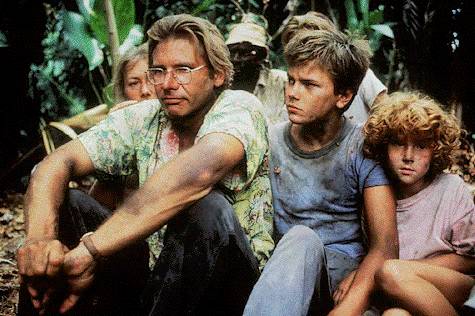
Or so Allie Fox and his family would like to believe. Fox, disillusioned with American culture and society, takes his family into the jungles of Central America in an attempt to live a more genuine, simple life. According to his son, Allie is an inventor; a genius. As they live in the jungle, Allie shows the natives what he believes will keep them from being savages—ice. Although the natives appreciate their newfound ice machine, Allie’s behavior soon becomes erratic and he fails to see just how dangerous his lifestyle has become. When his family begs him to leave, Allie refuses to go anywhere but up the coast, and each time their home is destroyed, they still keep moving until, ultimately, the family decides to take a stand.
Interestingly, Peter Weir directed this film which stars Harrison Ford (both of whom, respectively, directed and starred in Witness). Ford and River Phoenix give incredibly powerful performances, and the entire cast makes it easy to believe that they are a family unit.
I decided to watch The Mosquito Coast because it is the only River Phoenix film I had never seen. The most striking aspect of the movie is its tragic nature (on multiple levels). It is difficult to see the destruction of a family in the same way that it is hard to watch a man’s obsession ultimately become his downfall.
The movie is not distinctly 80s. Aside from Emily’s fashion choices and Allie’s jabs at the Japanese, all of the other aspects of the movie suggest that it could be taking place at any time. Especially taking into consideration the idea that technology and consumerism are ruining the U.S., The Mosquito Coast could easily take place in 2010.
Though I enjoyed the film, this movie is not for everyone. Its quiet nature and slow progression of plot may lead some down the road to boredom. Although I haven’t read the novel on which the film is based, I do wonder whether its slow nature would make it a better novel than film. Those willing to take a chance on this movie, however, will probably be struck by the power it holds.
Once upon a time...
St. Elmo's Fire (1985)
St. Elmo’s Fire follows a group of recent college graduates struggling to come to terms with their newfound adulthood. The movie has a fairly well-known cast, including Emilio Estevez (Kirby), Rob Lowe (Billy), and Demi Moore (Jules). A definite drama, all of the characters are running around looking for direction throughout the whole film, until ultimately Billy consoles Jules (and consequently everyone else) with the revelation that “we’re all goingthrough this.” Knowing that they are not alone seems to give the characters some balance.
The movie is quintessentially 80s. From the feathered hair and layered clothes to the female struggling to become a true “working woman,” St. Elmo’s Fire reeks of the 80s (not to mention the fact that the movie brings the Brat Pack together again). It’s a pretty dated film, but not so much that viewers are unable to relate to the characters and their situations. At its core, the movie is about a group of friends trying to live life as people for the first time; not as students, and for some, not as a couple, not as an addict, not as a virgin. It’s The Breakfast Club five years later, even if both films were released in 1985.
I enjoyed the film, but nowhere near as much as I thought I would. The acting is great, sure. But on some level I do find it difficult to relate to seven Yuppie-ish college graduates trying to find themselves in the real world, especially when the characters are a bit one-dimensional (they are essentially defined by the problems they are facing). The best thing about this movie is the mise-en-scene, and I appreciated all of the set details.
Despite any of the movie’s snags, it is cool to see actors from The Breakfast Club together in a more serious film, and I would recommend this movie to anyone who is a fan of the Brat Pack and other ultra-80s films. Anyone who is aching to compare the movie to the TV series ABC won in a bidding war might be interested in it as well. It might also be cool to watch the movie as a recent college graduate and to see if the dilemmas in the film are relatable in any way.
BIG
I really like when movies have a good moral, and I think BIG is one of them. Were always wishing away our time without thought, “Oh I wish it was Friday already,” or “Why isn’t it 3 yet??” and so on and so forth. But imagine if you were suddenly 30 years older, your whole life had passed you by, and you remember none of it? I think just a week would be enough to scare someone into being more appreciative of the time they have here. I think the film also works to how an adult who is able to maintain a childlike innocence is something to be admired. It’s very difficult to keep the ‘joie de vivre’ or joy of life that children seem to have so easily. I love the scene where he dances on the giant piano. We used to have a F.A.O. Schwartz here in Orlando with the same piano, and a Raggedy Ann sitting outside the store that was just as big as the building. It’s closed now, it was one of the first places to go when the bad times crawled in. Ironically our childlike tendencies are also the first to go when the bad times crawl in.