Tuesday, August 01, 2006


Monday, July 03, 2006
Blush and Bashful
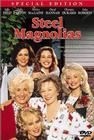 Steel Magnolias
(1989)
Starring
Sally Field, Dolly Parton, Shirley masculine, Daryl Hannah, Olympia Dukakis, and Julia Roberts
Also Starring
Dylan McDermmott, Tom Skerritt, and Sam Shepard
Every woman should see this movie, no matter what age. The best cast, the best story, the best characters. It is Julia Roberts coming out party, but hardly a Julia vehicle, it never gets old and you will never forget it.
The movie is written by and based on the screenplay by Robert Harling, who wrote the play after his sister died during childbirth from complications due to diabetes. It was filmed in the writers hometown using houses that were donated by the townspeople for the filming. The directors commentary features excellent notes on the filming, like all the clothes were purchased in thrift stores in the town, and all of the extras in the movie are local townspeople. Additionally, the nurses that care for Shelby are the same nurses that took care of the writer's sister before her death.
Steel Magnolias is the story of a diabetic woman, Shelby, who is at a turning point in her life, is ready to begin a life of her own and start a family. While the movie focuses brilliantly on the changing dynamics between Shelby and her mother (Sally Field), Steel Magnolias is a film with its heart solidly planted in the the South and the women who live there. It is a movie about all generations struggling to maintain the gentile nature of a Southern Belle while adjusting and growing into the modern, independent woman.
Shirley MacClaine and Olympia Dukakis almost steal the movie. The stellar supporting cast creates not only some of the most memorable humor, but there is also a depth in characters and their relationships that creates a sense of warmth and compassion. It sucks you in and takes you safely through this journey of southern life, at it's highest and lowest. The title really says it all: even the most beautiful and delicate of flowers can, with the support of loyal friends, be made of steel.
View the trailer
Aliens (1986)
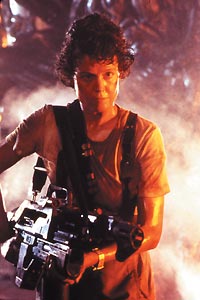
Aliens (1986)
Directed by James Cameron
Starring Sigourney Weaver
I watched the Ridley Scott-directed Alien (1979) recently for the first time recently. I liked the stark, quiet quality to that film. The minimalist approach to depicting the future worked well, I thought. Cameron uses more 'futuristic equipment' in this film, a lot of which look 'early 80s.' (The less there is, the least number of chances to mess up!) I appreciated Scott's stylized approach to the cinematography.
In the first film, warrant officer Ellen Ripley seems vulnerable at times when she challenges authority and doesn't quite get through, but keeps her head and holds her ground. Toward the end she kills her special male friend (boyfriend) along with others who have been captured, cocooned, and possibly impregnated; so she does what she has to, with little emotional confusion. The turns out to be the strongest, the one that was right all along, and the one who survives...with her cat, Jonesy.
The diversity of the crew in that film, a mixture of men and women that includes a black man, indicates that in the future, humans have found a way to exist without prejudice.
Ripley finally gets rid of the alien by having it sucked out of her shuttle. She doesn't use her weapon very much. Perhaps a one on one battle with the alien, in which she actually wins, didn't seem plausible to the filmmakers at the time.
When I began watching James Cameron's Aliens, I thought Ridley Scott's was way superior. (I did not have the luxury of seeing Aliens in widescreen format, which is a crime, I know. I would like to see it again to get the full scope of all the cinematographic techniques.) Besides the set design, the acting was better in the first film. Even Ripley's assertiveness in this film seems more deliberate and contrived than in the first film. Sigourney Weaver's voice seems deeper than before. I liked how in the first film, she was a normal woman who happened to be right and in control. She didn't have to seem 'masculine' and she didn't have to be 'sexy' to be tough. In one scene in Aliens she gets into the loader and proves that she can operate it just as well or better than any man. The military officers laugh a "Whoa! Check it out, she really can do it!" laugh. I don't know that that reaction would have happened in the first film...but maybe.
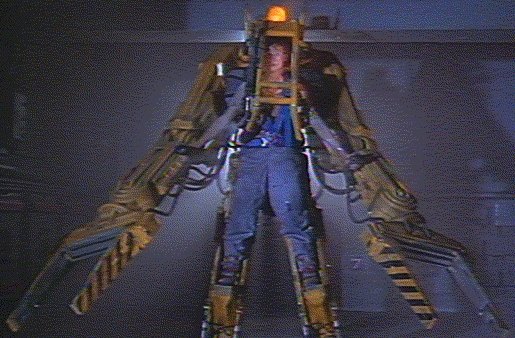 Ripley in the loader. Awesome.
I hated the characters in this film at first, especially Bill Paxton's. Man, is he irritating. They seem like testosterone-charged caricatures, compared to the ones in Alien. I didn't like the hyped-up emotional quotient to this film, as compared to the first. Gone is the social ease apparent in the first film; in its place are emotionally charged swearing and cheesy one-liners. Also, with these characters, it seems as though the prejudices of the early 21st century are still around, as the ethnicity of a Mexican character is referenced a couple of times in the first few minutes the audience meets her. It seems as though Cameron is trying to make the characters relatable to the audience. Anyway, as the film progresses, we realize that they aren't bad; they're just rambunctious soldiers. They redeem themselves because they fight bravely. Most importantly, they back Ripley up when she takes control.
Yes, Ripley takes over from commanding officer Lieutenant Gorman, who antagonizes her for half the film. He dismisses her repeatedly and in one critical scene when the on-ground crew members face danger, he doesn't take action based on her warnings until Burke (Paul Reiser) explains what she's saying to him. She finally wrests control away from him and despite Burke's efforts later to sabotage her in order to retrieve alien specimens, she saves the day again with the help of a little girl named Newt.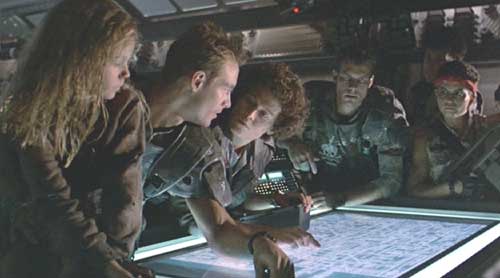
Veteran survivor Newt looks on as the military officers try to figure it all out.
As the film went on--probably about an hour into it--I began to appreciate the heavier concentration of action than in the first. I liked how Ripley actually takes on the queen alien, almost hand-to-hand (even though she needed a robot-suit-contraption to do it). Again, though, she doesn't kill it; she has it sucked out into space. But she destroys the nest and saves the remaining commanding officer, Corporal Hicks, and the android Bishop. (And Newt...who does get captured at one point. Heeeey, did the aliens impregnate her???)
 Ripley and Newt speak for the first time.
Newt in this film replaces Jonesy to show Ripley's soft side. She humanizes her. It's important that Ripley's toughness is balanced by her caring nature. I don't think it's a weakness that she is compelled to go back and risk everyone else's life to save Newt--her maternal instinct is a strength. I thought it was interesting that wanting to save Newt's life motivates her to load up with two gigantic guns (really, for the first time; she doesn't use her flamethrower too much in the first film and a man teaches her to use the other gun in this film...but she is eager and surprises him with her skills). Armed with a flamethrower AND a grenade launcher/rifle-thingy she takes on the nest site. If it were a male character saving a little girl, he'd still seem tough, not weak, for going back.
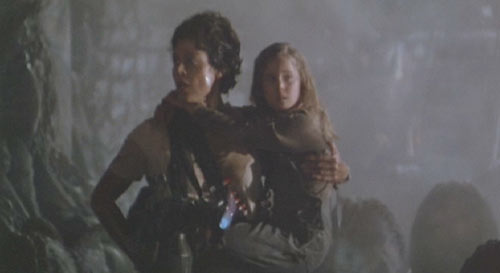
I liked one scene where a chain of the crew is making their way through a series of tunnels. Ripley is in front, directed by Newt. Vasquez, a woman, brings up the rear, holding off the aliens with her weapons. The guys are in the middle, protected and led by the women. I also liked another scene where Ripley roughs up the slimey Burke a little bit. He so deserves it.
I wonder if the alien is Ripley's alter ego, like Van Helsing/Dracula. Ellen kind of sounds like alien... Maybe that's a stretch.

Mirror image?
I think Ellen Ripley is a one-of-a-kind character in the world of female action heroes. She's held up well over the last almost 30 years, in terms of her strength as a female. Yes, she is in her underwear in a few scenes, and if you do a Google image search for 'Aliens' and 'Sigourney Weaver' you'll see lots of stills with Ripley in her underwear, but at least it's not revealing Victoria's Secret lingerie! And she's not in her underwear all that much in the first two films, anyway (though more in the second than the first). Overall, I think she kicks butt. Sigourney Weaver's Ripley doesn't rely on her sexuality to seem fierce in the same way as Angelina Jolie's Lara Croft or Anne Parillaud's Nikita. She seems more like a real woman, which is tough enough!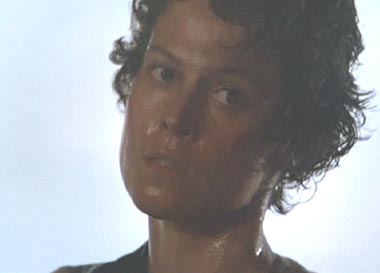
Sunday, July 02, 2006
Fantasia can arise anew

Forget Legend and Labyrinth with their scientologist forest children and ginormous codpieces, if you were a fantasy movie in the 1980s, you wanted to be Neverending Story.
After being picked on by bullies, Bastian retreats to the really creepy attic that is somehow located at his school. Once he begins reading the leatherbound book, the story shifts to the magical world of Fantasia that is on the verge of being completely destroyed by the Nothing. The only hope for Fantasia rests with the young hero, Atreyu, who can restore Fantasia by giving the Childlike Empress a new name. Aided by his trusty steed Artax and Falkor, a white dragon that used to scare the bejeezus out of me when I was young, Atreyu sets out on his quest to save Fantasia from the Nothing.

Neverending Story is really a unique children's movie in that it deals with the concept of death. While trudging through the Swamp of Sadness, Artax becomes trapped in quicksand and drowns. Watching it, even now, is incredibly depressing. The scene really adds to the film and I think contributes to the reason it hasn't fallen away along with countless other children's movies that are all sunshine and farts.
For the time, the special effects were quite good, although by today's standards are quite dated.
The one thing that always bugged me about the film was that damn dragon, Falkor. The wolf beast never bothered me, but that dragon was scary. I mean, look at him. Ugh, creepy.

Blood Simple (1983)

Blood Simple (1983)
Directed by Joel Coen
Written by Joel and Ethan Coen
Starring Frances McDormand, Dan Hedaya, John Getz, M. Emmet Walsh
Call me quirky, but I really like the Coen Brothers, and I haven't even seen all their films. Raising Arizona is one of my favorite movies; I first saw it when I was young and impressionable and it still holds up. I really enjoyed O Brother, Where Art Thou. Fargo made me feel uncomfortable, but I get it.
Blood Simple is suspenseful enough so I wasn't sure if it was okay to laugh. But some of it made me want to, though he subtle humor in this film, billed as a drama/suspense, is nowhere near as obvious as that of Raising Arizona.
SPOILER ALERT
It opens with the narration of one character who ends up dead, like in American Beauty...but we're not supposed to know that. Then... a recurring beat throughout the film that mimics a heart beat. We first hear it in the music in the opening credits over 'Blood Simple,' which synchronizes with the beat of windshield wipers. Later we hear it with footsteps and an an alarm clock.
I felt badly for all the characters, except for the scummy detective, played by M. Emmet Walsh (who also plays H.I.'s loud, obnoxious coworker in Raising Arizona). Even Abby (Frances McDormand), whom we think is shady and dishonest, earns our sympathy by the end.
The extended death scene was so pathetic at times it was almost funny. Ok some of it was funny. Not laugh-out-loud, guffaw funny...but funny enough that it makes you feel bad for thinking so.
I love the way the Coens craft their shots. There is a lot of zooming in from wide shots consisting of parallel lines that converge on a horizon, which speaks to the open Texas surroundings and also helps convey the underlying loneliness and alienation of some of the characters. The use of the handheld --- the excitement in some of the more suspenseful scenes.
I forgive the synthesized music because it works in this independent film. I think it adds to the film's charm, even though the film is a bloody drama. It works in comedies and bloody films for some reason.
Overall, I think the film holds up well. Something that is uncommon for an 80s movie: out of all the characters all the white males end up dead...and everyone else lives! Wow!
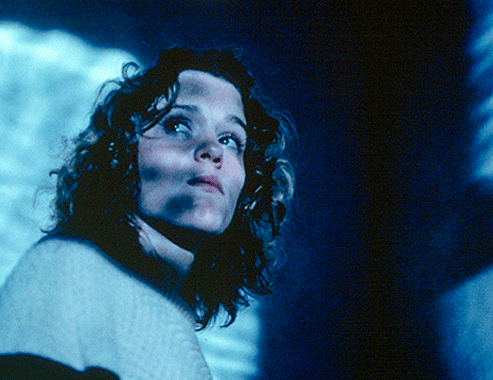
I noticed a couple of tiny things. When the detective is leaving Ray's house, someone is visible in the light to the right of the screen as soon as he gets outside. Is that a goof? Also, I could have sworn I saw Tom Cruise leaning against a car in a scene featuring a bunch of burnout kids (right before Marty meets the detective in his VW beetle).
I loved this film. I want to see it again because I know I missed some things the first time. I thought the ending was innovative and great...and pure Coen brothers. (Although I can see a Psycho influence with the dripping water...but it's still very much Coen, from what I know about film so far.)
If anything, the last month has inspired me to see every Coen brothers movie I've never seen.
AIRPLANE!...Need I say More
 The film Airplane! was produced in 1980. It is the spoof comedy that set the standard for all others that followed it. The famed Zucker Bros. achieved fame with this parody of all the airplane disaster flicks of the 70's. This is one of the ultimate dumb-but-funny comedies made in the 1980’s. There's no real plot. Just laughs - and plenty of 'em.
The storyline is unbelievably hilarious, all the things that could possibly go wrong on an airplane inevitably do. Ted Striker (Robert Hays) is a war veteran who decides to chase after his
 ex-girlfriend, an airline stewardess named Elaine (Julie Hagerty), right before her plane takes off, and he climbs aboard in order to woo her back. Once in the air the flight crew is poisoned by the chicken they had for dinner. The passengers on the plane eventually come down with the same illness as the crew. The onboard, Dr. Rumack (Leslie Nielsen) takes care of the sick passengers as Ted tries to fly and land the plane. In a particularly funny scene, the pressure becomes so unbearable that he begins to literally sweat gallons in the cockpit.
That is basically all the film is about, the rest of the film is spent cracking jokes. Spoof films are entirely different from other movies because normally we would criticize a film if it considered its plot to be the least important element. Not so here.
 Airplane!" not only was a huge success in 1980 (the year of its release), spinning off a horde of imitators and one sequel - it was also responsible for crowning Leslie Nielsen "The King of Spoof." This film today is considered to be responsible for literally inventing a sub-genre of comedy the “SPOOFS”.
He possess great skill!
 This was my undisputed favorite movie when I a child. How could it not be my favorite movie; it had ninjas, lots and lots of ninjas.
American Ninja is the story of generically named Joe Armstrong, a army recruit who just transferred to Hawaii. On a routine transport mission, the convey is beset by ninjas... because ninjas are common in Hawaii. Everyone dies but Joe and the colonel's daughter, of course, and Joe leads her to safety after unleashing some of his ninjas skills on a few of the attackers.
Unbeknownst to Joe, the ninja master was standing atop a nearby hill with his arms crossed, watching the entire event unfold. He swore vengence against Joe for disrupting the ninjas' attempt to steal military weaponry. I suppose the ninjas wanted the gun because they kept getting their asses handed to them when they tried to attack people with swords. Anyway, Joe teams up with fellow soldier, the stereotypically named Curtis Jackson; who fills the role of sidekick as well as token black guy.
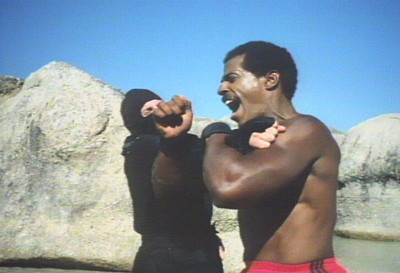 Throughout the movie, Joe and Jackson are attacked by ninjas again and again until they get to the stoic boss ninja. Joe kills him and everyone lives happily ever after; but not before Jackson blows up a helicopter with a rocket launcher.
It's easy to see why American Ninja was my favorite movie as a child, with the ninjas, explosions, and more ninjas. Watching it again, though, I'm saddened by how bad some of the choreography for the fight scenes were. I mean seriously, who dies after a shoulder throw?

I have no idea what the ninja in the back right is so happy about.
Indiana Jones and the Temple of Doom
 Hold on to your Potatoes!
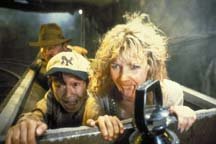
Indiana Jones and the Temple of Doom is the second in the Indiana Jones series. Dr. Jones begins the film in a nightclub with Lao Che and it’s there that we meet Willie Scott, the club’s whiney lounge singer. After an altarcation Lao Che, he has to make a run for it with Willie and his kid sidekick, Short Round in tow.
They end up in India where Dr. Jones is asked to find a village’s lost children and return their sacred stone. Dr Jones, Short Round and Willie trav
 el to a hilltop palace, not far from the village where there are whispers of evil deeds. When they arrive, they are treated to an interesting, if gross dinner by the young price of the land. He and his advisors insist that there is nothing going on with the palace and the ancient cult that used to use blood sacrifices at the palace no longer exists. It does. They get caught up in the deadly cult and fatal worship. Indy saves the kids (who are enslaved - digging for other lost magical stones like the one stolen from the village) and the prince who was brainwashed by the evil cult leaders. In the end everyone is saved, Indy gets the girl and the glory
 and treasure.
This movie is fun, but is about as deep as a puddle. It’s a lot like pop-rocks - at first it’s fun, but it gets damn annoying after a while. The music feels repetitive and the cuteness of the kid sidekick gets old fast. It hamstrings Indy’s character, which is already vulnerable because he has to protect the shrilling banshee of a leading lady. I know it is an adventure movie, but it travels too far into the realm of absurdity. The scene on the mine cars is fun, but too long, and the special effects are painfully dated. The film seems to be mocking adventure movies without meaning to. The first Indiana Jones movie felt inspired. The Temple of Doom felt too much like a Disney ride gone wrong - you know it’s going to end, and the end will be innocuous, but you can’t wait till the damn thing stops.
Under the Boardwalk...

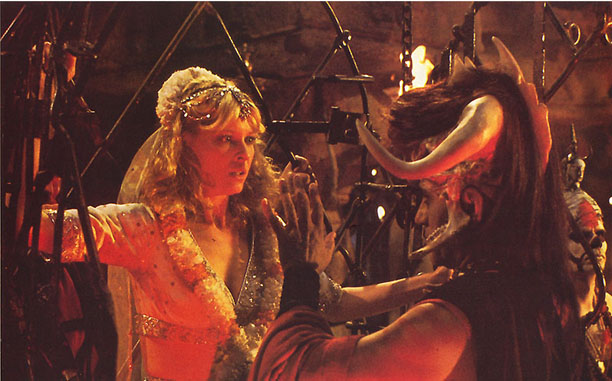
Beaches is a 1988 movie adapted by Mary Agnes Donoghue from the novel Beaches by Iris Rainer Dart, it was directed by Garry Marshall, and stars Bette Midler and Barbara Hershey.
Well-to-do girl Hillary Whitney and child performer Cecilia "CC" Carol Bloom meet under the boardwalk, literally, in Atlantic City. They become life long friends, growing up to supp
 ort each other through job changes, love problems and sickness. So I guess you could say there were there for each other, “for better or worse and through sickness and health”. There are a lot of great songs in this movie, some of which include “Wind Beneath My Wings”, “Under The Boardwalk”, “I Think is Going Rain Today”, “Glory of Love” and “Baby Mine”, just to name a few. One of my favorite parts in this movie is when “CC” (Bette Midler) is doing the play about industry and the creation of bras. You see a lot of great theatrics and cinematic elements in this part of the film. Most of the movie is about these two woman lives and how just because rich girl Hillary (Barbara Hershey) always seems to have it all although she really never gets it together. And you see “CC” always there to help to bail her out when her best friend is in need.
I think this is a classic drama because we see the friendship of two women last through all turbulence in their own lives. I think that woman can identify with this movie because we have all been through something like this.
Richard Attenborough's Film: Gandhi (1982)
Director: Richard Attenborough
Starring: Ben Kingsley, Rohini Hattangadi, Charlie Sheen, Candice Bergen
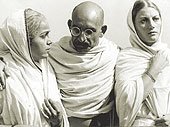
My first thought, after having watched this film the other night, was, “I can’t belieeeeeeeeeve I never saw this movie until now.”
Mohandas Gandhi, a Cambridge, UK educated lawyer, inspired by the prejudice he experienced in South Africa after passing the bar, initiated civil disobedience protests there to win civil rights for Indians. Moved on to his homeland, which he had to learn about since he had been educated abroad. He saw that British subjects of other nationalities on foreign soil (away from Great Britain) were treated like garbage. Given the title “mahatma” meaning “great soul”, he fought for Indian independence from England, using non-violent means. With his wife, Kasturba, by his side speaking for him whenever he was ill or in prison, Gandhi incited the people of India to stand up for unjust British rule using noncooperation.
Born into relative comfort and destined to be a successful lawyer, Gandhi could have been a rich man who accepted his privileged place in society as part of God’s order. But, the prejudices he had experienced inspired him to reject the India’s Hindu caste system, which divided society into four major groups, with the ‘untouchables’ at the bottom. He shed his European clothing and settled for a loincloth made from homespun Indian cotton to protest Britain’s dominance over India’s textiles. He also minimized his worldly possessions.
Gandhi considered himself and everyone else as “children of God,” no religion preferred over another. His believed that Muslim-Hindu unity in India was imperative to India’s success as an independent nation. However, when it became apparent that Muslims would not settle for potential subjugation under a Hindu majority in newly independent India, he agreed to the proposal that a new Islamic nation be created from India’s majority Muslim northwest corner, Pakistan.
When violence possessed Indian rebels to lash out at police and British officers, and when Muslims and Hindus began to turn against each other once India gained independence, Gandhi, considered the father of India at the time, went on dangerous hunger strikes. The people revered him enough to stop for a while so that he would live.
During bloody Muslim-Hindu strife, however, some extremist Hindus considered Gandhi a traitor for agreeing to the Muslims’ demands and called for his death. He was assassinated in 1948.
It is extremely difficult to blog about this movie in the context of a "1980s film" even though I thought was good, i.e. Attenborough did a great job pulling everything together. It is a well-done period piece. Therefore, the film is timeless, on the whole (I’ll get to why not entirely later). It was really long, complete with intermission, and dealt with an historical figure whom we Americans do not know enough about, so it’s hard to compare this portrayal of him because there is little or no point of reference. From what I saw, though, Ben Kingsley did an amazing job. (By the way, I never knew until now that Kingley’s father was from Gujarat, the same state as Gandhi, so he’s half-Indian.)
The sweeping cinematography, with wide shots of the Indian countryside, contributed to the epic feel of the film.
The major beef I have with this film is how it minimizes his the importance of his wife, Kasturba (played by Rohini Hattangadi). So often we get idealized portraits of great men. It would have been nice to see more of his relationship with his wife. It would have humanized him a bit. She was his partner. She 'fought' alongside him. She spoke for him. Her death in the movie, after decades of standing alongside him, gives us a hint of his grief, but then nothing! She is forgotten! But was he really that stoic in real life? In the movie, she obviously loves him, says he’s her best friend, and it's apparent she will do anything for him. They seem to be at ease when they’re together. But he barely reacts with emotion to her. I know he took a celibacy vow, but I thought he seemed a bit cold to her in a couple of scenes. Maybe it's just me.
I imagine that in 1982, her unyielding devotion to her husband seemed quite admirable, but I think if the film were made today we would have seen more of her influence on him. She had to have had some! She was his lifelong partner (they were married at 13). I cringed when she says, “My dignity comes from following my husband.” No, it doesn’t! You have your own dignity, girl!!
I know that a lot of spiritually motivated philanthropic men have had trouble treating those closest to them with the respect they deserve (MLK, Jr, John Lennon, for instance). The have the big picture on their minds and have little time for personal relationships. With Gandhi, the way he probably treated his wife probably reflected that as well as cultural shortcomings. But that doesn't mean she didn't have a profound influence.
Conversely, I think Attenborough was smart to leave out some of the more unsavory details of Gandhi's life. His aim was to show Gandhi not as a funny Hindu man in a loincloth, which is the perception a lot of Americans still have, but to show that he wasn't so different after all. In doing that, although the film did a good job with explaining his general religious/spiritual beliefs, I think it played down the influence Hinduism had on him and left out his advocacy of satyagraha.
Another thing the filmmakers did (the studio?) to sell the film to western audiences is apparent when you watch the trailer AFTER seeing the film. OK, I'll tell you the way it struck me: The Indian actress who played his wife is named LAST, after a bunch of European or American actors, many with smaller parts. Same thing on the cast list on IMDB... she's listed smack in the middle, after all the 'main' actors but before the secondary actors. That probably would have been different now, too.